Title:
How to enhance the resolution of an old DUV stepper tool and a comparison studio of maskless and mask aligners
Abstract:
Lithography is the key-enabling technology defining the critical dimensions and pattern fidelity of semiconductor devices and advanced microsystems. At DTU NanoLab, a broad lithography platform supports feature sizes ranging from hundreds of microns down to a few nanometres. This range is covered by our UV-aligners, a DUV stepper and e-beam tools. Besides the state-of-the-art performance we have also succeeded by different kind of tricks to go beyond the standard resolution limitations defined by the individual tools.
This presentation is divided into two parts.
First, I will present how we by the use of deep ultraviolet lithography and resolution enhancement techniques comprising dipole illumination, cross patterning, triple exposure and assist lines can receive higher lithographic resolutions than by conventional use of a DUV-stepper tool (Canon FPA-3000 EX4) equipped with a 248nm wavelength KrF excimer laser. We can thereby achieve gratings of 95nm dots with a pitch of 350nm. Line widths of 160 nm are obtained with a 380 nm pitch in 390nm thick resist, which is well below the standard limitation of resolution of 250 nm line widths. The obtained resolution is dependent on the shape of the patterns and the pitch size.
The second part of this presentation is a comparison study of maskless aligners and mask aligners, which was made to investigate whether we lose or gain something in the shift from conventional mask aligners to maskless aligners. There are pros, cons, and issues worth considering.
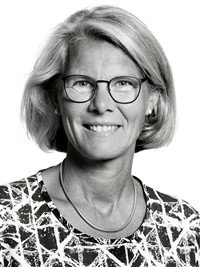
Dr. Karen Birkelund
Karen Birkelund received her M.Sc. degree from Roskilde University Center, Denmark in 1993 and her Ph.D. degree in electrical engineering in 1997 from the Technical University of Denmark (DTU). She has worked as a research engineer in various companies on micro and nanofabricated devices. From 2006, she worked for 5 years as an assistant professor at DTU Nanotech, working mainly on MEMS devices and encapsulation for harsh environments. Later, she joined DTU Nanolab as a process generalist. Since 2021 she has been Head of Lithography and Wet Chemistry at DTU Nanolab.